Today I want to look at one potential use case for an equitable governance structure in the form of a decentralized renewable energy cooperative. Energy co-ops are common in New England where I am from, but for those who are unfamiliar they are essentially community operated power companies. Instead of relying on suppliers like Eversource or National Grid, community members form a coalition to purchase electricity as one large unit, increasing their overall buying power to get a better deal from generation facilities. An energy co-op would be a good application for this type of system because you really wouldn’t be changing much of the organizational structure, just providing more transparency, equity, and fair decision making. For this example, we’ll imagine what a renewable energy co-op operating on a Decentralized Autonomous Organization model in the State of Massachusetts could look like, running on the Hedera Hashgraph DLT.
DRECMA
To understand how emerging technologies can enable more equitable governance of an electrical cooperative, it’s important to first explore the concept of a Decentralized Autonomous Organization (DAO). DAOs are community-led organizations that operate without a centralized governing body, instead relying on DLT-based smart contracts and governance tokens to facilitate decision-making. Unlike traditional organizations, where a board of directors or executives dictate policies, DAOs empower all members to participate directly in governance.
Decision-making is handled through governance tokens, sometimes referred to as utility tokens. These tokens represent voting power, often have monetary value, and can even be tied to underlying assets (such as electricity in our case). Members stake their tokens to propose and vote on key issues such as funding allocations, rule and personnel changes, or project development.
The execution of these decisions is enforced by smart contracts—self-executing programs stored on a DLT network that automatically trigger actions when predefined conditions are met. This structure ensures transparency, security, and automation, allowing DAOs to function efficiently and fairly without intermediaries or centralized oversight.
The energy policy and legal framework in Massachusetts makes it an ideal candidate for an organization such as the Decentralized Renewable Energy Co-Op of MA (DRECMA). The states ambitious clean energy goals under the Clean Energy and Climate Plan for 2050, equitable Net Metering policies, and Community Choice Aggregation laws create a welcoming landscape for innovative energy management concepts.
Another important factor is positive community sentiment towards responsible energy use. Massachusetts has a strong tradition of democratic innovation, academic excellence, and a culture that is tech-friendly and eco-conscious. Several renewable energy co-ops already exist within the state. There are also many opportunities for collaborative partnerships to support community engagement with state agencies such as Mass CEC and the Dept. of Energy Resources: Renewable and Alternative Energy / Green Communities divisions. Additional opportunities for community partnership are available from various public and private non-profits operating in the state as well.
The Structure
So, what would DRECMA’s governance and reward structure look like?
The framework would rely on the Co-Op’s governance token, $DREC to serve multiple functions:
- Membership and Governance
- Members pay annual dues in $DREC tokens.
- Holders can stake their $DREC to vote on cooperative proposals, eliminating the need for a centralized governing committee.
- Reputation-weighted voting can ensure fair decision-making. (More active participants who pay dues, produce energy, and regularly vote for passing proposals gain governance weight).
- Energy Payments
- Members can pay electricity bills with $DREC at a discount to incentivize adoption, resulting in reduced reliance on fiat payments and strengthening the internal token economy.
- Incentives For Renewable Energy Producers
- Households or businesses that supply excess renewable energy back to the grid earn $DREC.
- Token issuance is pegged to kilowatt-hours generated. For the rest of this article, we’ll use a rate of 1 $DREC = 0.5 kWh. I’ll go over why I picked this rate later.
- Users can also earn $DREC for providing energy storage to stabilize the grid.
- Rewards reduce the need for individuals to rely on traditional net-metering programs.
- Infrastructure
- Members may create proposals to fund the creation of community owned facilities such as battery storage or wind power generation sites.
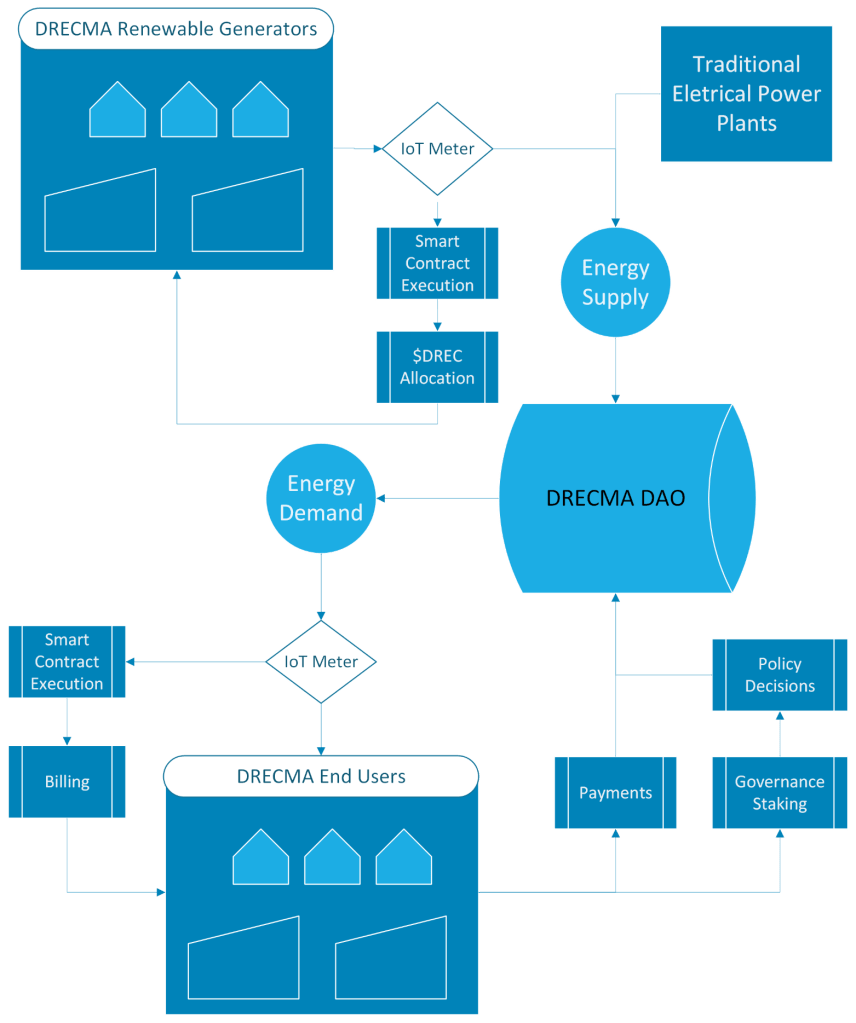
- Adoption of Internet-of-Things (IoT) enabled technology would provide a direct interface between the digital network and physical components of the system.
- This approach would allow real-time energy accounting for both metering and generation.
DRECMA Organizational Flowchart
$DREConomics
Next, I think it’s important to connect the value of $DREC to its real-world underlying asset, electricity. I chose the value of 0.5 kWH = 1 $DREC based on practical, current data that will support a healthy circulating supply without excessive inflation:
- Aligning with Current Electric Rates in MA:
- The average price of electricity in Massachusetts during 2024 was ~$0.26 per kWh.
- This would mean that 0.5 kWh = 1 $DREC = $0.13 USD in energy value.
- Comparing Net-Metering & REC Incentives:
- Net-metering programs typically credit solar producers between $0.15 to $0.20 per kWh.
- Renewable Energy Credits (REC’s) trade between $0.03 to $0.07 per kWh.
- The valuation of $DREC (~$0.13 per kWh) sits in between these figures, providing competitive, sustainable incentives to participate.
- Dynamic Conversion Rate:
- 0.5 kWh = 1 $DREC is a good place to start, but the conversion rate would need to change dynamically to respond to market conditions.
- Token supply will be facilitated by smart contracts to mint $DREC when members produce renewable energy.
- When members use $DREC to pay bills, a fraction of the tokens are burned to prevent inflation and ensure long-term sustainability.
At this point it would be helpful to establish some additional figures for the organization to establish real-world context. Imagine that DRECMA has 10,000 members compromised of 70% residential and 30% businesses. We’ll use 10,200,000 kWh (10.2 GWh) as an estimate for what that monthly electricity demand would be for the Co-Op based on real usage rates for MA homes and businesses. I’m also going to assume that renewable energy options have already been widely adopted by the community. Let’s say 30% of members have solar panels that produce an average of 650 kWh per month, for a total of 1,950,00 kWh (1.95 GWh). In addition, 5% of members operate small-scale wind or larger solar arrays. These installations could each provide an additional 10,000 – 30,000 kWh per month, resulting in an average 5,500,000 (5.5GWh) of generation. This brings the total generation capacity of DREC to 7.45 GWh per month.

Conclusion
We’ve covered a lot of ground in this post so I’m going to wrap this up. But before I do there is one more point to consider that ties this all together. At this point its clear that DRECMA could serve as an alternative solution for operating an electrical co-op. But what remains unanswered is why do all of this in the first place? The answer is simple: equitable governance.
Traditional electrical cooperatives operate as a member-owned, non-profit organization. Participants buy into the co-op and elect a Board of Directors to make major decisions. The board will usually oversee activities such as:
- Setting electric rates and service policies.
- Develop budgets and investment strategies (infrastructure upgrades, power purchasing).
- Hires management and operating staff to execute policies and procedures.
This model offers many advantages to the community over reliance on major utility companies. But there are still issues that could be improved:
- Limited member participation – Members only vote periodically, usually once a year to elect new board members.
- Slow decision-making – Board meetings are infrequent, making it difficult to respond dynamically to market changes.
- Opaque operations – Budgeting, rate decisions, and contract details often lack real-time transparency.
- Clean Energy Sources – Oftentimes, co-ops struggle to compete with the incentives offered by larger utility companies for private renewable generators.

An electrical co-op operating as a DOA, such as DRECMA, would take the best elements of the traditional model and enhance equity in governance, energy sourcing, member rewards, and more through access to decentralized decision-making. With some refinement, DRECMA could be a viable, scalable model that could redefine how communities generate, share, and govern their energy. With the right tools, this vision could be implemented today, creating a future where energy is not only renewable, but also truly equitable.
 Opt-in governance
Leave a comment